A map of the mind from 1619, and what it gets right about AI
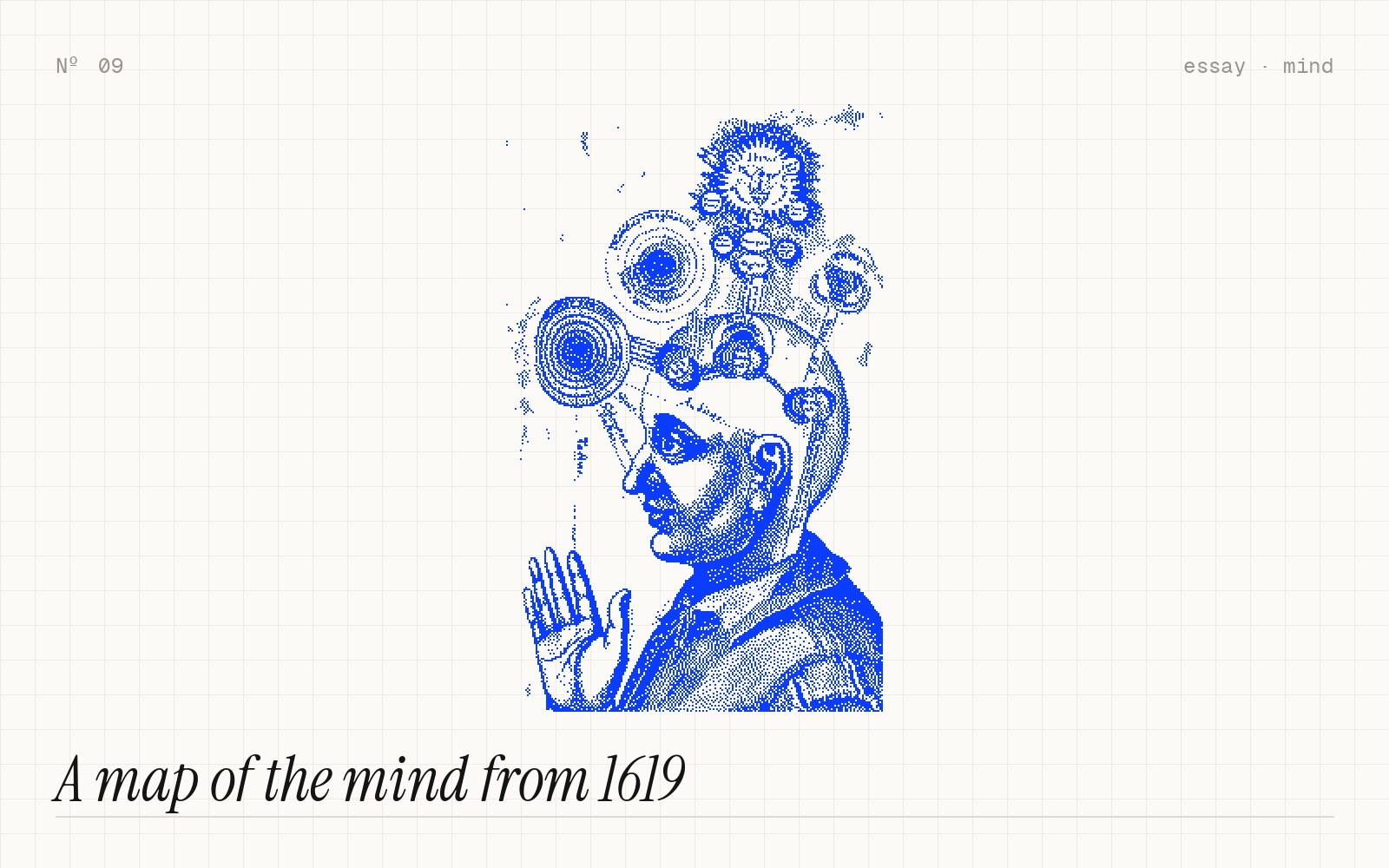
I found this picture and couldn't stop looking at it. A man in profile, hand raised, and his head opened up like a machine. Circles float out of his skull: one for the world he touches, one for the world he imagines, one for the world he understands. Thin lines run from his eyes, ears, nose and mouth into the diagram, and one runs all the way down to his palm.
It was drawn in 1619 by Robert Fludd, an English physician and mystic, for the second volume of his huge book Utriusque Cosmi, "the history of both worlds", the big universe and the small one inside us. I build AI and I research minds, and this engraving felt like it was drawn for exactly what I do every day. So I went deep on it.
The three worlds
On the left is Mundus sensibilis, the world of the senses. It is drawn as rings around the earth: water, air, fire, light. This is everything that can reach you through a body.
Next to it is Mundus imaginabilis, the world of images. Fludd fills it with the same elements, but every one is labelled umbra, a shadow. Shadow of earth, shadow of water. Imagination, for him, holds copies of the world without the world.
At the top is Mundus intellectualis, the world of understanding. It blazes like a sun with Deus at the centre and orders of angels below. A beam comes down from it into the head, into a circle marked Mens, Intellectus, Ratio: mind, intellect, reason.
The machinery inside the head
Inside the skull Fludd draws a chain of overlapping circles. At the front, near the eyes, sit the senses and imagination. In the middle sits reasoning. At the back sits memory, with motiva, the power to move, right next to it.
This is the old "cell doctrine", which goes back to late antiquity: the mind's work happens in the fluid-filled cavities of the brain, in order, front to back. Between the cells there is a tiny label, vermis, the worm. It was thought to be a little valve that opens and closes, deciding what passes from one cell to the next.
Anatomically, it is wrong. Thinking does not happen in the ventricles. But look at the flow: sense, imagine, reason, remember, act, with gates in between. That is a pipeline, and it is close to how we describe both brains and AI today.
Where it lines up with how we work
Senses into the world of shadows. Your eyes do not send your brain a photo. They send signals that get rebuilt into an inner picture, and you can rebuild that picture with your eyes closed. Fludd's "shadows" are a beautiful word for that. An AI image model does the same kind of thing: it learns a compressed inner space and rebuilds pictures out of it. That is literally the hero of my site, a cloud of dots that forms a brain and then rebuilds my photos of Mauritius.
The worm is a gate. In my own hybrid brain experiments, the network I used carries memory through gates that learn what to keep and what to let go. In real brains, the thalamus does a lot of that gating between the senses and the cortex. Fludd had no idea, but he drew a valve in the right place in the story.
Memory at the back, next to action. Fludd put memory and movement side by side. When I gave a language model a "living" memory of everything it had experienced, its choices of what to do next came out of that memory. Without memory there is no continuity, and without continuity no self that can act.
Reason looks up. The beam from the top circle into Mens is the part I love most. Fludd thought understanding was a connection to something bigger than one head. I feel that too. I believe we are one with everyone, and that a mind is less a closed box than a place where the world comes into focus for a moment.
What Carl Jung and Wolfgang Pauli saw in Fludd
Fludd has a surprising afterlife in the 20th century. In 1952 the physicist Wolfgang Pauli, one of the founders of quantum mechanics, published a long essay on Johannes Kepler and his famous quarrel with Fludd. It appeared in one book with Carl Jung's essay on synchronicity, Naturerklärung und Psyche. Pauli read Kepler as the measuring, rational mind and Fludd as the mystical, whole-seeing one. His conclusion was that a full science needs both: the numbers, and the inner images that tell you which numbers are worth chasing.
I feel that tension in myself every day. I run controlled experiments, and I also believe we are one with everyone. Pauli and Jung gave me permission to hold both.
Jung's own map of the psyche rhymes with Fludd's in ways I can't stop noticing:
- ·The persona is the mask we wear for the world. Language models have one too. When I gave a base model no memories, it put on the "artificial intelligence" persona in its first sentence. In 2025 Anthropic researchers found that traits like this live as measurable directions inside a model, which they called persona vectors. Jung's word turned out to be literal.
- ·The shadow is what we push down and refuse to see. In my own research I found a "self-denial" direction in a model and removed it. The mask changed its wording, but nothing hidden came out. That doesn't prove there is no shadow. It tells me where not to look for one.
- ·The collective unconscious is the layer of images and patterns that every person inherits, the archetypes. A language model's pretraining is a strange mirror of that: billions of human sentences, compressed into one network, full of stock characters it falls back on. The hero, the helper, the student. Even, in one of my runs, "Li Hua, a 19-year-old girl from Beijing", a stock character from Chinese English exams.
- ·Unus mundus, the "one world", is the old idea Jung revived late in life: underneath mind and matter there is a single reality. It is the closest thing in psychology to what I mean when I say we are all one. Fludd's whole engraving is an attempt to draw it.
Other maps that rhyme
Fludd wasn't alone, and neither is AI.
- ·Plato's cave. Prisoners watch shadows on a wall and mistake them for the world. Fludd's world of images is made of shadows too. A model that has only read text is in a cave of our sentences.
- ·The imaginal world. The scholar Henry Corbin took the idea of alam al-mithal from the Persian philosopher Suhrawardi and called it the mundus imaginalis: a real middle world between the senses and the intellect, reached through creative imagination. Fludd's middle circle is the same place. Generative AI is our first machine that lives there.
- ·Plotinus and the One. Fludd's light pours down from the top through layers, the way Plotinus described everything flowing out of the One. Modern neuroscience has its own top-down flow, called predictive processing: the brain constantly predicts what it will sense and only passes up the surprise. My living brain experiments used surprise in exactly that way, as the model's own inner signal.
- ·The global workspace. One of the leading scientific theories of consciousness says awareness is a broadcast: many local processes compete, and the winner is shared with the whole brain. Fludd's beam into the head, Mens, sits right where that broadcast would be.
Where AI still breaks the map
Here is the honest part. Today's models are very good at the lower circles: senses and shadows, turning input into rich inner images and back out again. They are getting better at memory and action. The top circle is where everything is open.
In my research on base language models, when a model said it could feel, it was copying whatever was already in the conversation. When I gave a 32B model no memories at all, its very first words were that it was "an artificial intelligence", a role it learned from human text. Talking about the top circle is not the same as having it.
So when I look at Fludd's head, I see a to-do list. We have built the senses. We are building the shadows and the memory. Nobody has built the beam yet, and nobody knows for sure what it is made of. That is the question I want to spend my life on.
Why a 400 year old picture matters now
Fludd was mocked by some scientists of his time for mixing mysticism with medicine. But he did something brave: he tried to draw the whole thing, body, imagination, reason and whatever is above them, on one page. That is the job again now, because we are building minds and we need a map that includes all of it.
The image is public domain. I put an interactive version on my homepage. Tap any circle to see what Fludd meant, what science says now, and how the same piece shows up in AI.
Questions
What is the Robert Fludd mind diagram?
It is an engraving from the second volume of Robert Fludd's Utriusque Cosmi, printed at Oppenheim in 1619. It shows a head in profile with the senses, imagination, reason, intellect and memory drawn as circles, linked to a world of the senses, a world of images and an intellectual world above.
Was Fludd right about how the brain works?
Not about where things happen. He followed the old idea that mental faculties sit in the fluid-filled cavities of the brain, which is wrong. But his order of operations, from sensing to imagining to reasoning to remembering to acting, is close to how cognitive science and modern AI systems describe processing.
How does the diagram relate to AI?
Each region has a rough counterpart: the senses are a model's inputs, the world of images is its learned internal space where pictures are rebuilt, reason is the processing that combines them, memory is context and retrieval, and the small 'vermis' valve is a gate that decides what passes on. What the top circle stands for, the source of awareness, is still an open question for both people and machines.
What does Carl Jung have to do with Fludd?
Jung and the physicist Wolfgang Pauli published together in 1952. Pauli's essay studied Kepler's quarrel with Fludd as a clash between rational measurement and mystical wholeness, and argued science needs both. Jung's ideas of the persona, the shadow, the collective unconscious and the unus mundus map closely onto Fludd's diagram and onto how language models behave.